
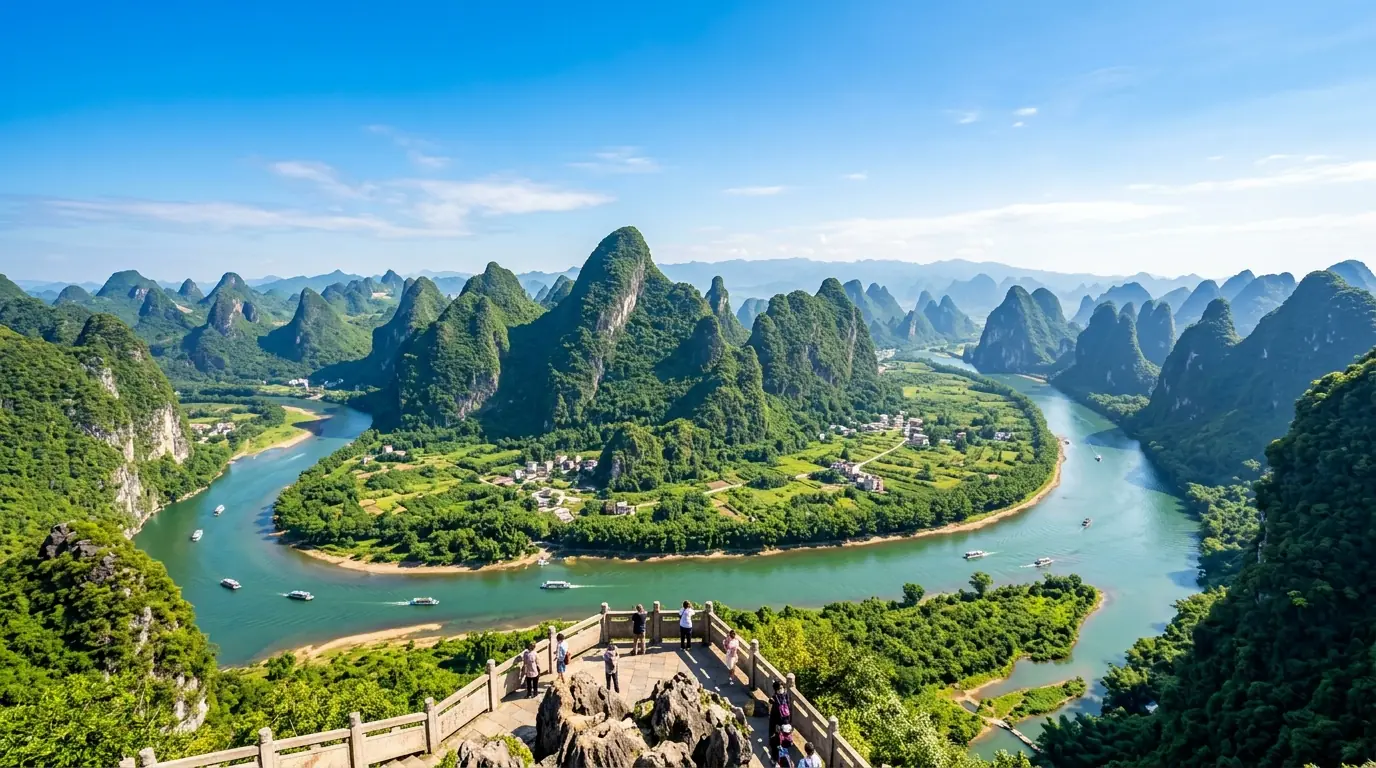
Every travel brochure in the world quotes the proverb: “Guilin’s landscape is the finest under heaven” (桂林山水甲天下). But 95% of tourists have no idea that this is not an ancient fairy tale—it is a literal poetic inscription carved into solid limestone right here in 1201 AD during the Southern Song Dynasty!
Located in the center of Guilin’s downtown core, the Jingjiang Princes’ Palace (靖江王府) is the city’s only National 5A cultural landmark, offering a rare fusion of Ming Dynasty imperial architecture, civil service examination lore, and a thrilling 306-step karst peak climb.
1. Imperial Citadel: Older Than Beijing’s Forbidden City
Constructed between 1372 and 1392 AD by Zhu Shouqian (the grandnephew of the Ming Dynasty’s founding emperor Zhu Yuanzhang), this palace complex predates Beijing’s Forbidden City by over three decades.
Enclosed by massive crenelated ashlar stone walls with four grand gates, the citadel hosted 14 Ming Princes across 257 years. During the Qing Dynasty, it was converted into the Guangxi Provincial Imperial Examination Hall (广西贡院) where thousands of scholars competed for civil service posts, and later served as the military headquarters of revolutionary leader Dr. Sun Yat-sen in 1921. Today, it also houses the historic campus of Guangxi Normal University.
2. Essential Visit Logistics
| Metric | Field Verified Details | Traveler Advice |
|---|---|---|
| Admission | ¥100 RMB (~$14 USD) per adult | Includes guided narrative tour, palace courtyards, Duxiu Peak climb, and examination hall. |
| Opening Hours | 08:00 – 18:00 Daily | Early morning entry (08:30) avoids tourist bus crowds and midday heat on the stairs. |
| Summit Elevation | 216 meters above sea level (~66m climb) | 306 steep, narrow limestone steps. Approx. 15–20 minutes to ascend. |
| Guided Tour | Included with admission ticket | Standard group tours depart every 15–20 minutes from the entrance arch. |
| Adjacent Sites | Dongxi Xiang (东西巷) & Xiaoyao Tower | Located directly outside the southern palace wall; easily combined on foot. |
3. The Pilgrimage: Dushuyan Cave & The 1201 AD Inscription
At the eastern foot of the central limestone tower lies Dushuyan Cave (读书岩, Study Cave). In the late 5th century during the Southern Dynasties, famous poet Yan Yanzhi studied and wrote poetry inside this natural limestone recess.
More crucially, it was here in 1201 AD that local prefectural administrator Wang Zhenggong (王正功) penned a poem to inspire young students passing through Guilin for the imperial exams. On the cave cliff face, visitors can stand directly in front of the world-famous carved characters:
「桂林山水甲天下,玉碧罗青意可参」
“Guilin’s scenery is the finest under heaven; its emerald jade peaks and ribbon-like waters reveal nature’s ultimate contemplation.”
Photographing this authentic 820-year-old cliff engraving is one of the ultimate cultural highlights of visiting China.
4. Summiting Solitary Beauty Peak (独秀峰 · “Pillar of the Southern Sky”)
Rising dramatically from the dead center of the palace courtyards like a colossal natural obelisk, Solitary Beauty Peak (Dú Xiù Fēng) is affectionately nicknamed the “Pillar of the Southern Sky”.
The Climb:
- 306 steep stone steps curve along the rock face, flanked by iron handrails.
- Several stair sections reach 60-degree inclines; sensible walking shoes or sneakers are mandatory (high heels are strictly prohibited).
- At the top stands Wangjiang Pavilion (望江亭), offering an unobstructed 360-degree panorama of downtown Guilin: Elephant Trunk Hill to the south, the serpentine Li River to the east, Diecai Hill to the north, and an ocean of tooth-like limestone peaks extending to the horizon.
5. The Imperial Examination Hall & Souvenir Pitfalls (小红书避坑贴士)
During the guided walkthrough, visitors are led into the reconstructed Guangxi Gongyuan Examination Hall (贡院):
⚠️ Commercial Pitch Warning (贡院拓片与吉祥物推销):
Visitors are invited to sit in scholar examination booths and take a mock Qing Dynasty trivia test with mock ink brushes. Afterward, an “exam result announcement” ceremony takes place, followed by an elaborate demonstration of royal rubbing art (拓片) and birth-year zodiac patron deity amulets (本命太岁).
Staff will present commemorative ink rubbings and amulets costing upwards of ¥200–¥1,000 RMB. While the historical demonstration is entertaining, you are under zero obligation to purchase. A polite “Bù yòng le, xièxie” (No thank you) is completely respected.
6. Effortless Pairing: Dongxi Xiang (东西巷) & Xiaoyao Tower (逍遥楼)
When you exit the palace through its southern gate, you step directly into Guilin’s premier restored historic pedestrian district:
- East-West Alleys (Dongxi Xiang / 东西巷): Grey-brick Qing Dynasty merchant alleys filled with local tea houses, Guilin rice noodle shops, and handicraft boutiques.
- Xiaoyao Tower (逍遥楼): A magnificent multi-tiered Tang Dynasty wooden tower overlooking the Li River. It is completely free to enter and illuminated with golden lanterns after 19:00 each evening.