
1. The 2,200-Year-Old Hydraulic Miracle: Why Lingqu Matters
While the Grand Canal of Beijing-Hangzhou is famous for its immense length, Lingqu Canal (灵渠) predates it by over 800 years and represents a vastly more intricate hydraulic triumph. Commissioned in 214 BC by Qin Shi Huang (the First Emperor of China), Lingqu was engineered by imperial architect Shi Lu (史禄) to solve an impossible military dilemma: how to transport grain and supplies across the towering Nanling Mountains to supply 500,000 soldiers conquering the Baiyue kingdoms.
Shi Lu discovered a geological saddle point near modern Xing’an where the headwaters of the Xiang River (flowing north to the Yangtze) and the Li River (flowing south to the Pearl River and South China Sea) sat just a few kilometers apart. By sculpting the natural riverbed with four interconnected masterworks, Qin engineers successfully united northern and southern China’s water networks for the first time in human history:
Huazui (铧嘴 · The Plowshare Dyke)
A wedge-shaped stone breakwater protruding into the Xiang River like the tip of an iron plow. It mechanically divides the incoming torrent: 70% flows northward into the Yangtze basin, while 30% is diverted south into the Li River.
Da & Xiao Tianping (大小天平 · Balance Spillways)
V-shaped chevron stone weirs that passively regulate water levels without motorized gates. During dry winter months, they hold back water to feed the canal; during monsoon floods, excess surge spills harmlessly over the low stone crests back into the main riverbed.
Doumen (陡门 · The World’s Earliest Flash Locks)
Constructed with vertical stone grooves and wooden flashboards, these locks enabled cargo barges to climb and descend gradient drops. Invented over 1,000 years before European canal locks, they are the direct evolutionary ancestors of the Panama and Suez locks.
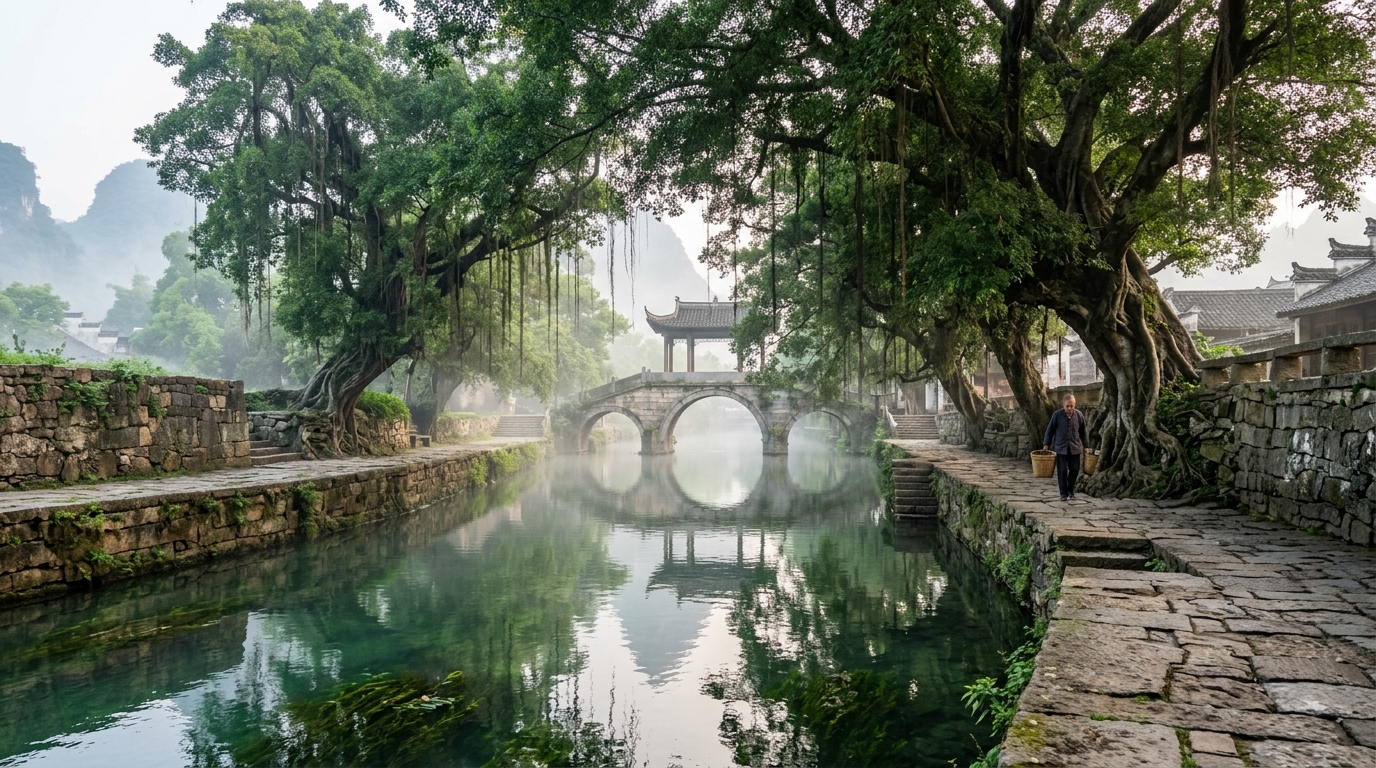
Qin Embankment (秦堤 · Banyan Stone Levee)
A 2-kilometer reinforced embankment lined with centuries-old banyan and camphor trees whose dense root networks anchor the stone dyke against hydraulic erosion, creating a tranquil waterside promenade.
2. Field Secrets & On-The-Ground Highlights (The Insider Route)
Most generic group tours rush tourists through the main souvenir plaza and leave within 45 minutes, completely missing the site's authentic charm. Drawing from verified local traveler notes, here is how to experience Lingqu like a true cultural insider:
📷 The Morning Mist Walk on Qin Embankment (秦堤)
Arrive between 08:30 and 09:30 AM. Enter through the south gate and walk along the stone path under the sprawling canopy of giant banyan trees. The canal water is so clear that submerged emerald ribbon weeds (水草) dance vividly beneath the reflections of ancient stone bridges. It is one of the quietest, most photogenic heritage corridors in southern China.
🏮 Strolling Xing’an Millennium Water Street (千年水街)
Immediately outside the South Gate lies the Xing'an Water Street—a public, non-ticketed pedestrian canal walk flanked by Qin-Han and Lingnan architecture. Stone footbridges arch over the gentle waterway, dotted with traditional teahouses, wood-carving workshops, and red paper lanterns. At twilight, the glowing lantern reflections on the canal water create a scene straight out of ancient Chinese poetry.
🍜 The Real Cradle of Guilin Rice Noodles (兴安米粉)
Local culinary historians agree: Guilin Rice Noodles were born right here in Xing'an. When Qin Shi Huang’s northern soldiers marched south, they fell severely ill from eating southern sticky rice. Imperial military cooks invented a method of grinding soaked rice, steaming it into dough, and pressing it into round strands resembling northern wheat noodles. In Xing'an, traditional shops still boil the rich spiced gravy (卤水) with dozens of traditional Chinese herbs.
3. Complete Transit Logistics: How to Get to Lingqu Canal
Xing'an is located 65 km north of Guilin city center. You have two highly practical options depending on whether you value speed and budget, or door-to-door comfort:
| Mode | Cost | Transit Time | Step-by-Step Procedure |
|---|---|---|---|
|
Recommended DIY Bullet Train + Local Taxi |
¥35–¥45 total | ~40 mins total Train: 22–30m | Taxi: 10m |
1. Take high-speed train from Guilin North (桂林北) to Xing'an North (兴安北) (¥18–25 on 12306/Trip.com). 2. Exit Xing'an North and hail official metered taxi or DiDi (¥15–20) straight to Lingqu Visitor Center (灵渠景区售票处). |
|
VIP & Delegates Private Chauffeur / Van Direct |
¥500–¥750 / day | 75–90 mins Door-to-door expressway |
Direct pickup from Ronghu Hotel or Liangjiang Airport. Driver waits on site while you explore, with secure onboard luggage storage. Perfect for combining with Reed Flute Cave on the return trip. |
4. Curated Post-Conference Itineraries for WCC Delegates
For delegates attending the World Canals Conference between October 12 and 16, extending your stay across Guangxi's iconic landscapes is an unmissable opportunity. Below are three battle-tested routes designed for maximum beauty with minimal friction:
Lingqu Hydraulic Deep-Dive & Xing'an Old Town
• Morning: 08:30 train from Guilin North to Xing'an North. Explore the Qin Embankment, Huazui divider, and the ancient flash locks.
• Lunch: Authentic dry-tossed Xing'an Rice Noodles with crispy pork cracklings in town.
• Afternoon: Walk along the Millennium Water Street and visit the modern Lingqu Museum to study hydraulic models. Return to Guilin by 16:30.
From Ancient Waterways to Karst River Cruising
• Day 1 (Lingqu Heritage): Dedicated excursion to Lingqu Canal and Water Street. Evening stroll around Guilin's Two Rivers and Four Lakes (Sun & Moon Pagodas).
• Day 2 (Li River to Yangshuo): Morning 4-star luxury cruise down the Li River from Mopanshan to Yangshuo. Check into countryside resort in Yulong Valley.
• Day 3 (Quiet Karst Country): Morning non-motorized bamboo rafting on the Yulong River (Shuiedi to Gongnong Bridge), electric scooter country loop, evening Impression Sanjie Liu light show.
Lingqu Canal, Yangshuo & Longji Rice Terraces (Golden Autumn)
• October Advantage: Mid-October is the legendary "Golden Harvest" season in the Longji Rice Terraces. The cascading mountain terraces turn vivid golden amber right as the conference concludes.
• Day 1: Lingqu Canal ancient hydraulic study.
• Day 2: Li River Cruise & Yangshuo countryside.
• Day 3: Private scenic drive into Longsheng; hike the Dazhai (Jinkeng) Yao minority terraces.
• Day 4: Sunrise over the golden dragon terraces; private transfer back to Guilin Airport (KWL) for international departure.
5. Bilingual Survival Cards (Show to Drivers & Station Staff)
English proficiency in Xing'an County is virtually zero outside official conference staff. Save or screenshot these cards on your mobile device:
Need a Private Van or Post-Conference Tour for WCC 2026?
Skip crowded buses and language barriers. Whether you need a private English-speaking driver to Lingqu Canal, an airport pickup, or a seamless 3-day extension to Yangshuo & Longji, our team matches you with vetted, insured local operators.
6. Frequently Asked Questions (FAQ)
Is Lingqu Canal worth visiting if I am not a civil engineer?
Yes, thoroughly. Unlike industrial canal basins, Lingqu is integrated seamlessly into a lush subtropical landscape. The stone-paved Qin Embankment under 500-year-old banyan trees offers one of the most serene, crowd-free cultural walks in Guangxi, paired with the atmospheric water town architecture of Millennium Water Street.
How much time is needed to tour Lingqu Canal?
Plan for 3 to 4 hours on site. This allows a relaxed 1.5-hour walk across the Qin Embankment, Huazui, and Balance Weirs, followed by 1 hour exploring Water Street and enjoying an authentic bowl of Xing'an Rice Noodles. Including bullet train transit from Guilin, it makes for a comfortable half-day or 6-hour excursion.
Can I bring large luggage to Xing'an?
Yes. If you book a private chauffeured vehicle, your luggage stays locked safely inside the car throughout your visit. If traveling by train, the Lingqu Scenic Area Visitor Center (南门游客服务中心) offers staffed luggage deposit lockers during opening hours (08:30–17:30).