
Many first-time travelers struggle to choose between Guilin’s two premier limestone caverns:
Choose Reed Flute Cave if you are based in downtown Guilin, want a short 1-hour cultural visit with minimal stair-climbing, or have an evening flight from Guilin Airport (KWL).
Choose Silver Cave if your itinerary is centered in Yangshuo, you prefer a much larger multi-level hike (2 km long), and want to combine it with countryside cycling in Gaotian.
1. The “Palace of Natural Arts” & State Guest Pedigree
Named after the verdant reeds growing outside its entrance—which locals traditionally carved into sweet-toned musical flutes—Reed Flute Cave was rediscovered by local villagers taking shelter during World War II air raids.
Opened to the public in 1962, it quickly became China’s premier “State Guest Cave” (国宾洞). Over the past six decades, more than 300 world leaders, heads of state, and international dignitaries have toured its subterranean galleries, including US Presidents Richard Nixon and Jimmy Carter, UN Secretary-General Kurt Waldheim, and French President Jacques Chirac.
Ink calligraphic inscriptions on the cavern walls date back to 792 AD during the Tang Dynasty, proving that ancient Chinese scholars and poets explored its chambers with pine torches over 1,200 years ago.
2. Iconic Cavern Chambers & Optical Marvels
The walkable cavern route spans approximately 500 meters along a U-shaped loop that takes roughly 50 to 60 minutes to tour at a relaxed pace.
1. The Crystal Palace of the Dragon King (水晶宫)
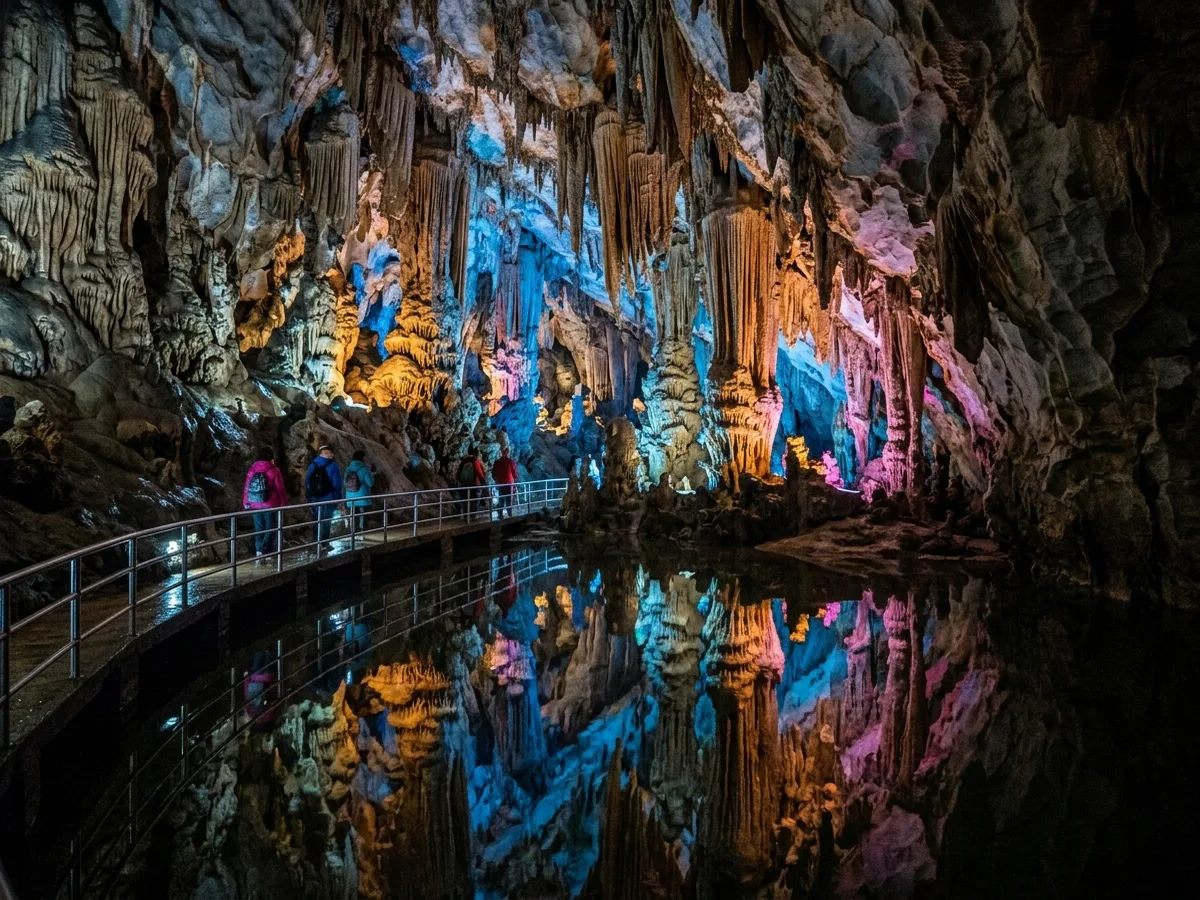
The cave’s grandest natural auditorium. A soaring 18-meter-high ceiling shelters a glassy subterranean pool that creates a mirror-perfect optical reflection of stalactite pillars above. The water is so limpid that looking down into the pool gives the dizzying sensation of gazing into a bottomless crystal chasm.
2. The Dragon Pagoda & Pine in the Snow (雪松凝翠)
Delicate, needle-like gypsum stalagmites that mimic a snow-dusted Himalayan pine tree standing beside an ancient Buddhist pagoda, artistically back-lit in deep amber and jade green.
3. The Modern Multimedia Ceiling Projection
In the central cavern hall, high-lumen 4K laser projectors cast an animated visual retelling of Guilin’s prehistoric geological transformation—from a primordial seabed into towering karst peaks—directly onto the undulating limestone ceiling.
3. Practical Logistics & Photography Tips
| Parameter | Field Specification |
|---|---|
| Admission Fee | ¥70 RMB / Adult (Instant QR ticketing via passport verification at entrance) |
| Interior Climate | Steady 20°C (68°F) year-round; comfortable in short sleeves in summer, light layer in winter |
| Accessibility | 90% flat concrete walkway with gentle handrails; accessible for active seniors and children |
| Tripod Policy | Handheld photography permitted; professional large tripods may require permit during peak hours |
[!TIP] Photography Exposure Tip: Due to high-contrast neon and LED spotlighting, turn off your camera flash. Set your smartphone to Night Mode (2-second exposure) and rest your elbows on the stainless steel safety railings for sharp, noise-free reflection photos.
4. How to Get to Reed Flute Cave from Downtown Guilin
Situated on the slopes of Guangming Hill along the Peach Blossom River, Reed Flute Cave is easily accessible from any central Guilin hotel:
- By Private Taxi / Driver (Recommended): ~15–20 minutes from Central Square (中心广场) or Xiangshan District (approx. ¥20–¥30 RMB on meter, or included in private day tour charter).
- By Public Bus: Take Bus Line 3 from Guilin Railway Station directly to the Ludi Yan (芦笛岩) terminus stop (approx. 40 minutes, ¥2 RMB cash/Alipay).
- Proximity to Guilin Airport (KWL): Located in the northwestern sector of the city, making it an ideal 1-hour final stop before taking the airport expressway to catch an evening flight.