
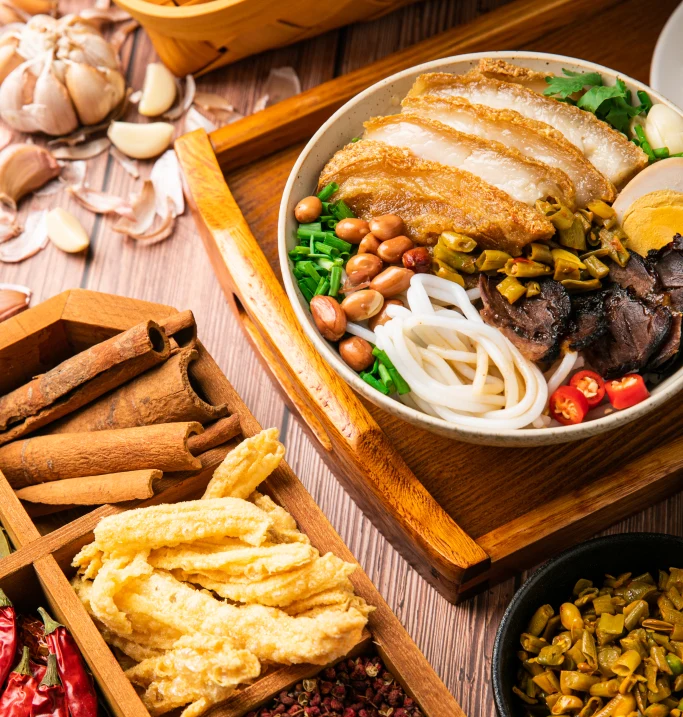
In Guilin, breakfast is not merely a meal; it is a sacred civic pulse. Every single morning across this ancient karst municipality, upwards of one million bowls of freshly extruded, silky rice noodles (Mifen, 米粉) are consumed before 9:00 AM.
For international visitors, however, eating rice noodles in Guilin often begins with bafflement. You walk into a noisy tiled shop, receive a dry plastic bowl containing bare noodles and meat slices with no broth in sight, and see local patrons furiously stirring their bowls with chopsticks while leaning over low wooden stools.
To experience Guilin noodles like a born-and-bred local, you must understand the centuries-old battle between Downtown Classic Dry-Mix (卤菜干捞派) and Northern Quanzhou Fiery Red Oil (全州红油热汤派), master the crispy honeycomb pork belly (Guoshao, 锅烧), and learn the inviolable 80/20 Bone Broth Rule.
1. The Great Divide: Dry-Mix Classic vs Quanzhou Red Oil
Guangxi rice noodle culture is divided by geography, climate, and philosophy. Downtown Guilin sits in a damp karst basin where dense herbal brines prevail, while northern Quanzhou County (全州县) borders cold mountain corridors that demand steaming pork bone broths and fiery chili oil.
| Dimension | Downtown Classic Dry-Mix (经典卤菜干捞粉) | Quanzhou Red Oil Hot Broth (全州红油热汤米粉) |
|---|---|---|
| Primary Base | Concentrated, pitch-black 30-herb master brine (Lushui, 卤水) | Rich, milky white bone marrow & yellow soybean broth (Datang, 大汤) |
| Noodle Texture | Medium-thick round noodles (Mafen, 马粉), slippery and chewy | Fine, freshly pressed extruded noodles (Xizhafen, 细榨粉), delicate and soft |
| Hero Topping | Honeycomb crispy fried pork belly (Guoshao, 锅烧) & lean beef slices | Slow-simmered savory minced pork (Roumo, 肉沫) & whole soft soybeans |
| Chili Profile | Fermented chili paste (剁椒) or dried chili oil; added voluntarily | Wok-seared local chili flakes drowned in blazing red pork fat oil (Hongyou, 红油) |
| Eating Method | Mixed completely dry; finish 80% before adding boiling bone broth | Served piping hot in bubbling broth; sweat-inducing from the very first slurp |
| Local Price (2 Liang) | 5.5 – 6.5 RMB ($0.80 – $0.95 USD) | 6.0 – 7.5 RMB ($0.85 – $1.05 USD) |
2. Anatomy of the Downtown Classic: The Dry-Mix Legend
If you order “soup noodles” (Tangfen, 汤粉) at a downtown Guilin noodle joint, the noodle master will secretly shake their head. The soul of downtown Guilin rice noodles lies strictly in the dry mix.
Fermented round noodles, served lukewarm and elastic at room temperature.
Simmered bone broth concentrated with star anise, cassia, dried tangerine peel, and luohanguo.
Pork belly with crackling blistered skin plus thinly sliced marinated beef shank.
Pickled long beans (酸豆角), sour fermented bamboo shoots (酸笋), and fried golden soybeans (酥黄豆).
Fresh scallions, cilantro, and fragrant roasted chili oil flakes.
The 30-Herb Master Brine (卤水)
Every respected noodle matriarch guards her brine vat with her life. Unlike Cantonese sweet char siu marinades or Sichuan spicy numbing soups, Guilin’s Lushui is an intensely concentrated, savory herbal reduction brewed with pork knuckles, beef marrow bones, dried river snails, aged tangerine peel (Chenpi), star anise, cinnamon bark, round cardamom (Baidoukou), local monk fruit (Luo Han Guo), fermented tofu (Furu), and aged rice wine.
It is reduced for over 18 hours until it turns a deep mahogany color. Only a single ladleful (about 2 tablespoons) is splashed over your noodles—just enough to coat every strand without pooling into a soup.
The Holy Grail: Guoshao (锅烧 - Honeycomb Crispy Pork Belly)
No bowl of classic Guilin noodles is complete without Guoshao. This is culinary alchemy:
- Premium three-layer pork belly is parboiled in herbal water until firm.
- The chef uses a cluster of sharp metal needles to prick tens of thousands of microscopic perforations into the pork skin.
- The skin is rubbed with aged rice vinegar and coarse sea salt to pull out moisture.
- The slab is plunged skin-down into bubbling lard at precise temperature intervals, causing the skin to explode into an airy, golden, honeycomb crunch that stays shatteringly crisp even when tossed through thick brine.
When you bite into a fresh piece of Guoshao, the exterior crackles like glass, followed instantly by melting, fragrant fat that lubricates the chewy rice noodles.
3. The Sacred 4-Step Slurping Ritual
Most foreign travelers ruin their first bowl of Guilin noodles by heading straight for the hot broth vat and drowning their noodles before eating. Do not do this.
Follow this local four-step protocol:
Step 1: Order “Er-Liang Lucai Fen” (二两卤菜粉)
At the cash register, pay for Er-Liang (二两 = 100 grams of dry noodle weight, which yields a generous adult portion of cooked noodles). Hand your ticket to the noodle cook behind the glass window. Watch them plunge the noodles into boiling water for exactly 8 seconds, flick the bamboo basket dry with a swift wrist snap, dump them into a bowl, ladle the dark brine, and swiftly slice pork belly and beef atop the pile.
Step 2: Navigate the Condiment Bar (配料台)
Pick up your bowl and walk over to the complimentary condiment bar. Here is the local pro-ratio:
- Pickled sour long beans (酸豆角): 1 heaping spoonful (adds crunch and acidity to cut the pork fat).
- Pickled sour bamboo shoots (酸笋): 1 small spoonful (pungent, fermented, distinctly southern Chinese umami).
- Fried crispy soybeans (炸黄豆): 1 spoonful (delivers nutty texture).
- Chopped scallions & cilantro (葱花香菜): A pinch for freshness.
- Chili oil (辣椒油): Taste your noodles first! Guilin chili oil packs serious heat.
Step 3: Stir Furiously and Eat 80% Completely Dry
Take your chopsticks and lift from the very bottom of the bowl upward in a circular motion. Stir for 15–20 seconds until every strand turns glistening brown with glossy herbal brine. Slurp down the first 80% of the bowl completely dry. Savor the contrast between chewy rice noodles, tangy pickles, and crackling pork belly.
Step 4: The Hot Bone Broth Finale (大骨汤收尾)
When only 3 or 4 mouthfuls of noodles and savory residue remain at the bottom of your bowl, carry it to the large stainless-steel thermal cauldron located in the corner of the shop. Depress the spigot or use the long ladle to pour boiling, unsalted pork knuckle bone broth (Datang, 大汤) until your bowl is half-full. Swirl it with your chopsticks. The hot broth dissolves the remaining concentrated brine, creating a rich, soothing, aromatic herbal soup that warms your stomach and completes the meal.
4. The Northern Contender: Quanzhou Red Oil Rice Noodles (全州红油米粉)
While dry-mix noodles dominate downtown streets, travel 90 minutes north towards Quanzhou County—or visit one of the authentic diaspora stalls along Guilin’s Xifeng Road (西风路)—and you enter the fiery universe of Quanzhou Red Oil Rice Noodles.
Hair-thin rice noodles pressed fresh into boiling water per order.
Pork bones & yellow soybeans simmered overnight into creamy nectar.
Crushed Xiaomila chilis scalded with sizzling pork lard & rapeseed oil.
Seasoned ground pork topping with butter-soft stewed soybeans.
Unlike downtown noodles which are pre-pressed, genuine Quanzhou stalls keep a hydraulic or wooden lever press suspended directly above a boiling cauldron. Rice dough is extruded on the spot in hair-thin white strands (Xizhafen), boiled for 30 seconds, and transferred into deep porcelain bowls.
Next comes the magic:
- The Soybean Marrow Broth: Pork backbones, trotters, and hundreds of grams of local dried yellow soybeans are simmered overnight until the liquid turns creamy white and the soybeans become buttery soft.
- The Red Oil (红油): Quanzhou red chili oil is legendary. Dried pointed chili peppers (Xiaomila) are hand-ground in stone mortars, blended with Sichuan peppercorns and garlic, and scalded with sizzling hot pork lard and rapeseed oil.
- The Eating Experience: The bowl arrives ablaze in a vivid crimson blanket of fragrant oil floating over white broth. With your first bite, the fine noodles glide effortlessly down your throat, carrying the fiery aroma of roasted chilies and the deep, comforting sweetness of stewed soybeans. It is Guilin’s ultimate hangover cure and winter antidote.
5. Avoiding Tourist Traps: The 5-RMB Back-Alley Rule
Rice noodles are a government-monitored staple in Guilin. By local municipal convention, a standard Er-Liang (二两) bowl of classic noodles in everyday residential neighborhoods costs between 5.5 and 6.5 RMB (~$0.80 to $0.95 USD).
- The Scenic Area Markup: Shops located immediately outside Elephant Trunk Hill, Reed Flute Cave, or Yangshuo West Street frequently charge 25–35 RMB for "Special Set Bowls" (套餐). They use stale noodles, pre-cooked soggy pork, and watered-down brine.
- The Pre-Broth Error: Any shop that automatically pours soup into your bowl without asking is catering to clueless tour groups. Real locals would immediately send it back.
- The Plastic Stool Indicator: The best noodle joints in Guilin have greasy tiled walls, no English signage, and customers sitting on tiny 6-inch red plastic stools on the sidewalk. Follow the morning queue of elderly locals and taxi drivers.
6. The Hall of Fame: 4 Authentic Guilin Noodle Dens
If you want an unforgettable bowl, bookmark these battle-tested local institutions:
Legendary Guoshao crackling pork; open since 1950s near East River Bridge.
Clean, English-friendly ordering, open 24/7 across multiple downtown branches.
Heavy, deeply herbal monk fruit brine; beloved by local railway workers.
Freshly extruded fine noodles bathed in crimson chili oil and soybean broth.
- Lao Dongjiang Rice Noodles (老东江米粉总店)
- Address: No. 3 East Jiang Road, Qixing District (七星区东江路3号, near East River Bridge).
- Signature: The uncontested emperor of Guoshao pork. The skin is blistered to absolute perfection. Get there before 9:30 AM before the morning pork belly batch runs out.
- Minggui Rice Noodle Chain (明桂米粉)
- Locations: Branches throughout downtown (e.g., Zhongshan Middle Road & Jiefang Bridge).
- Signature: While a modern chain, Minggui adheres strictly to non-material cultural heritage standards. Their 30-herb brine is simmered with monk fruit, and their dining rooms are clean, bright, and easy for foreigners to navigate.
- Tiexi Anxin Rice Noodles (铁西安新米粉)
- Address: Tiexi Residential District, Xiangshan District (象山区铁西小区).
- Signature: The epitome of a working-class Guilin diner. Thick, dark, intensely fragrant brine with a heavier garlic aroma and generous meat cuts for just 6 RMB.
- Quanzhou Red Oil Noodle Stall (西风路全州红油米粉)
- Address: Near intersection of Xifeng Road & Rongyin Road (秀峰区西风路).
- Signature: Watch the master press fine white noodles straight from dough into the cauldron. Order with “extra yellow beans” (Jia Huangdou, 加黄豆) and a soft-boiled fried egg (Hebaodan, 荷包蛋).
7. Bilingual Ordering Flashcards
Screenshots these cards on your smartphone to order effortlessly at any counter:
Plan Your Guilin Culinary Pilgrimage
Experiencing Guilin’s culinary soul is best done on foot in the early morning mist before city buses clog the old streets. If you are continuing on to the Li River Cruise or taking the high-speed train to Yangshuo, grab a steaming bowl of Er-Liang near the station:
- High-Speed Rail Connection: Check train schedules from Guilin to Yangshuo or Guangzhou via Trip.com High-Speed Rail Booking.
- Stay in the Historic Heart: Sleep within walking distance of Guilin’s legendary morning markets at premier downtown hotels via Trip.com Guilin & Yangshuo Hotels.
- Stay Connected: Use high-speed mobile data to translate menus and navigate back-alleys with an instant Klook China Travel eSIM.