
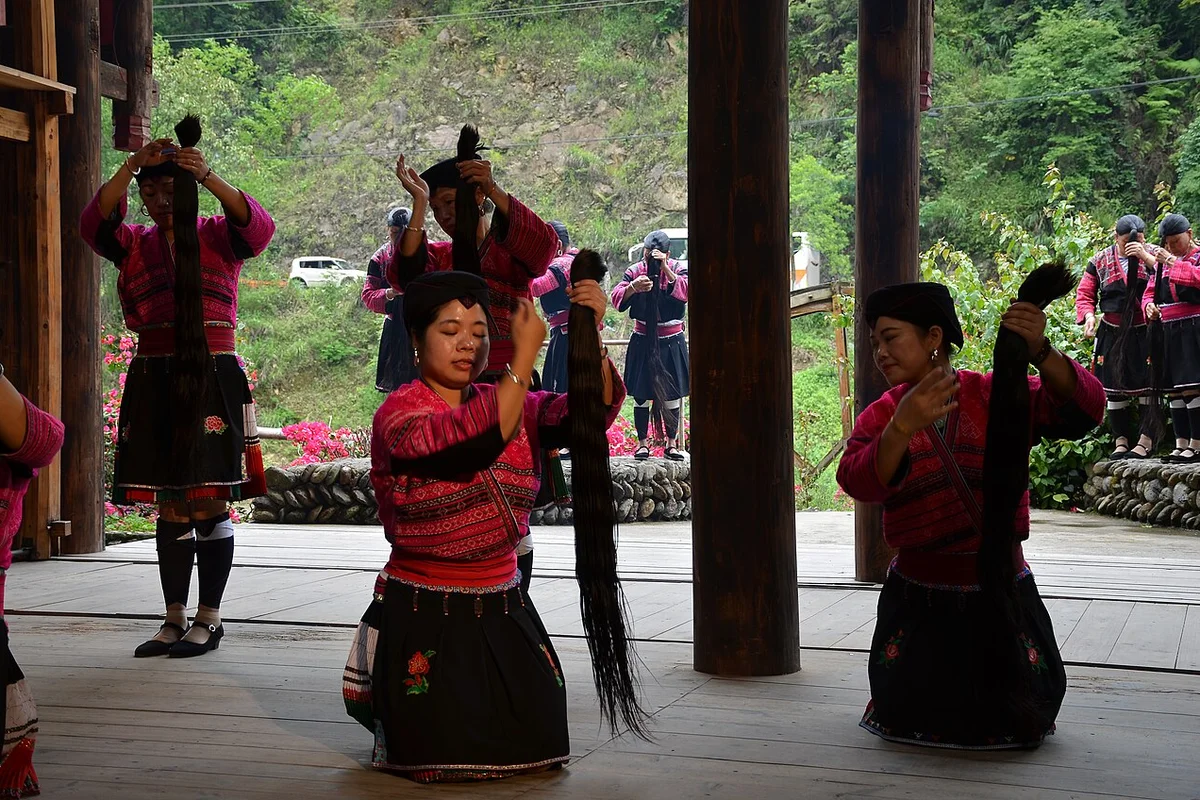
Nestled along the rushing waters of the Jinsha River at the base of the Longji Rice Terraces lies Huangluo Yao Village (黄洛瑶寨). Recognized by the Guinness Book of World Records as the “World’s First Long Hair Village,” Huangluo is home to approximately 80 Red Yao (Hongyao, 红瑶) families where women have cultivated floor-length, shimmering black hair for dozens of generations.
Across the globe, beauty influencers and dermatologists marvel at the village’s signature phenomenon: 80-year-old Yao grandmothers with thick, radiant, jet-black hair without a single strand of gray—and not a single drop of synthetic dye.
Yet, like many world-famous ethnic enclaves, Huangluo has attracted aggressive commercial hype, staged bus tours, and overpriced “miracle bottled shampoos.”
Here is the authentic, ground-truth guide to Huangluo: the true botanical science behind their fermented sour rice water, how to decode the three marital hairstyle secrets, and how to experience the village ethically as a peaceful 45-minute stopover on your way up to the rice terraces.
1. The Living Legend: Why Red Yao Women Grow Hair Over 2 Meters
In traditional Red Yao cosmology, a woman’s hair is not cosmetic decoration; it is her vital essence (Qi), her ancestral connection, and a sacred vessel of longevity and prosperity.
Every mature Red Yao woman’s elaborate headpiece is composed of three distinct sacred hair sets:
Grown continuously from the scalp since her 18th birthday.
The single ritual haircut received upon entering adulthood at 18.
Collected strand-by-strand from every comb stroke since adolescence.
The Once-in-a-Lifetime Haircut (成人礼)
A Red Yao woman is permitted to cut her hair only once in her entire lifetime—during her coming-of-age ceremony on her 18th birthday.
This severed lock is preserved by her mother in a decorative wooden chest. When the woman marries, the cut lock is returned to her. Furthermore, from adolescence onward, she never discards a single fallen hair strand from her wooden comb. She saves every shed strand, weaving them into a supplemental bundle.
When you see a Red Yao woman uncoil her hair, she is unspooling three lifetimes of woven family history totaling over two meters in length.
2. The Botanical Science: Fermented Rice Water & Tea-Seed Pomace
How do 80-year-old women working under harsh mountain sun maintain raven-black, breakage-free hair without graying? The secret lies in a century-old herbal shampoo brewed in large earthenware jugs.
Rich in inositol, vitamins B & E, and hair-strengthening amino acids.
Aged until naturally sour (pH 4.5–5.0), matching the ideal slightly acidic scalp mantle.
Infuses essential citrus oils, natural shine enhancers, and a fresh botanical aroma.
Natural botanical saponins that create a gentle, residue-free clarifying foam.
Stimulates scalp blood microcirculation and preserves natural dark melanin.
The Biochemical Mechanism
- Fermentation & Inositol (肌醇): When rice water ferments, yeast and lactobacillus convert carbohydrates into amino acids, pantothenic acid, and high concentrations of inositol. Modern trichology confirms inositol penetrates damaged hair shafts, repairing elasticity and remaining inside the cortex even after rinsing.
- Acidic Mantle Match (弱酸性): Pure water has a pH of 7.0, and chemical shampoos are often alkaline (pH 7.5–8.5), which forces open hair cuticles and causes frizz. Fermented rice water naturally drops to pH 4.5–5.0, matching the natural acidic mantle of human scalp and sealing the cuticles flat for mirror-like light reflection.
- Tea-Seed Saponins (茶麸天然表面活性剂): The cake residue left after cold-pressing mountain camellia tea-seed oil (Chafu) is packed with natural plant saponins. It lathers gently, cutting scalp sebum without stripping essential lipids.
- Citrus Essential Oils: Boiling with wild pomelo peels neutralizes the sour fermented vinegar aroma, leaving the hair scented like fresh citrus blossoms while fighting dandruff.
3. How to DIY Authentic Yao Fermented Rice Water at Home
You do not need to buy expensive bottles online. You can make genuine Yao rice water right in your kitchen:
- Rinse & Collect: Take 1 cup of unwashed white glutinous rice (or standard short-grain rice). Add 3 cups of spring water. Vigorously rub and massage the grains with your hands for 3 minutes until the water turns milky white. Strain the liquid into a clean glass mason jar (cook the rice for dinner!).
- Ferment (7–10 Days): Seal the jar loosely and leave it at room temperature (around 22–26°C / 72–78°F) for 7 to 10 days. The liquid will develop a slightly sour, tangy smell like rice wine. That acidity signals that active inositol and beneficial enzymes have peaked.
- Herbal Boil: Pour the sour fermented liquid into a saucepan. Add the fresh peel of 1/2 grapefruit or orange (substituting wild pomelo), 3 slices of fresh ginger, and 1 teaspoon of green tea leaves. Bring to a gentle boil for 5 minutes. The citrus completely neutralizes the sour aroma.
- Cool & Wash: Let the brew cool until comfortably warm. Pour over your scalp and hair, massaging gently into the roots for 5 to 10 minutes. Rinse thoroughly with clean warm water. Use 1–2 times per week.
4. The Three Hairstyle Codes: Marital Status at a Glance
In ancient times, a Red Yao woman’s hairstyle served as an immediate visual passport. Just by glancing at how her hair was coiled, any villager could tell whether she was single, married, or a mother:
| Frisuren-Struktur | Soziale & Eheliche Bedeutung | Visuelle Merkmale |
|---|---|---|
| 1. Verhülltes Tuch (黑布包头) | Unverheiratete junge Frau (未婚少女) | Verborgenes Haar unter schwarzem Tuch; früher nur vom Ehemann in der Hochzeitsnacht gesehen. |
| 2. Schnecken-Dutt (前额螺丝髻) | Verheiratet mit Kindern (已婚已育) | Markanter hornartiger Dutt vorne auf der Stirnmitte zur Feier der Nachkommenschaft. |
| 3. Flacher Haarkranz (盘平头 / 扁平盘发) | Verheiratet ohne Kinder (已婚无子) | Gleichmäßig und flach um den Schädel gewickelter Haarkranz wie ein Heiligenschein. |
- The Secret Scarf (Unmarried): Historically, an unmarried girl never displayed her hair in public. Her hair was bound, wrapped in a black cloth scarf, and tucked beneath an embroidered headpiece. If an outsider accidentally saw her bare uncoiled hair, tribal custom required him to live with her family as a laborer for three years! Today, unmarried young women still wear their hair covered or braided.
- The Forward Snail Bun (Married with Children): After giving birth, a woman’s hair is coiled in a bold, prominent horn-shaped bun right on the front edge of her forehead (Luosiji). The forward-facing bun honors the birth of descendants and the continuation of the family lineage.
- The Flat Coiled Crown (Married without Children): If a woman is married but has not yet had children, her hair is wound smoothly and flatly around the perimeter of her skull like a crown, with a decorative scarf wrapped over it.
5. Scam Prevention: How to Visit Huangluo Without Traps
Because Huangluo sits directly on the highway between the Longji entrance gate and the mountain terrace villages (Ping’an and Dazhai), commercial operators target foreign tourists aggressively.
Trap 1: Overpriced Bottled “Yao Rice Water” (¥98–¥168). Street stalls along the suspension bridge sell plastic bottles labeled “100% Pure Yao Rice Water Shampoo.” In reality, most are mass-produced commercial chemical formulas mixed with artificial fragrance made in factories far away. Do not buy them; make your own at home using our recipe above.
Trap 2: The Staged Commercial Theater Ticket (¥80). Tour buses herd groups into an auditorium for an expensive 20-minute scripted singing and hair-uncombing show with booming loudspeakers. It feels plastic and rushed.
Trap 3: Unsolicited Hair Touching & Photo Fees. If a local elder invites you to touch her hair on the roadside, clarify whether she expects a 20–50 RMB gratuity before touching or filming.
The Smart Traveler’s Strategy: The 45-Minute Private Stopover
The most rewarding way to experience Huangluo is as a quiet stopover while traveling from Guilin or Yangshuo to the upper terraces via private car:
- Have your driver park near the Jinsha River suspension bridge.
- Walk across the wooden bridge into the residential wooden stilt houses (Diaojiaolou).
- Skip the ticketed theater and wander into the quiet upper village where grandmothers sit on their wooden verandas spinning thread and combing their hair in natural morning light.
- If an elder offers to demonstrate how she coils her hair, a polite 20 RMB token of appreciation is customary and deeply appreciated.
- After 45 minutes, return to your private car and continue up the mountain to Dazhai or Ping’an.
6. Bilingual Cultural Etiquette & Photo Flashcards
Use these cards on your smartphone to interact respectfully with village elders:
Seamless Travel to Longji Rice Terraces
Visiting Huangluo Yao Village is seamless when integrated into a direct countryside transfer from Guilin or Yangshuo:
- All-Inclusive Longji Terrace Tickets: Reserve your official Longji scenic area entry passes in advance via Trip.com Longji Terrace Entrance.
- Direct Private Car with Huangluo Stop: Avoid waiting for crowded public shuttle connections. Book a private car that waits for you at Huangluo before climbing up to your mountain lodge via InsideGuilin Private Mountain Transfers.
- Small-Group Cultural Day Tours: Prefer a guided tour with an English-speaking minority culture guide? Book via Klook Longji Minority Cultural Tour.