
China Mainland 5G High-Speed Travel eSIM (Instant QR Code Delivery)
From $3.50 USD · Direct Access to Google, WhatsApp & Instagram · 1–30 Day Plans
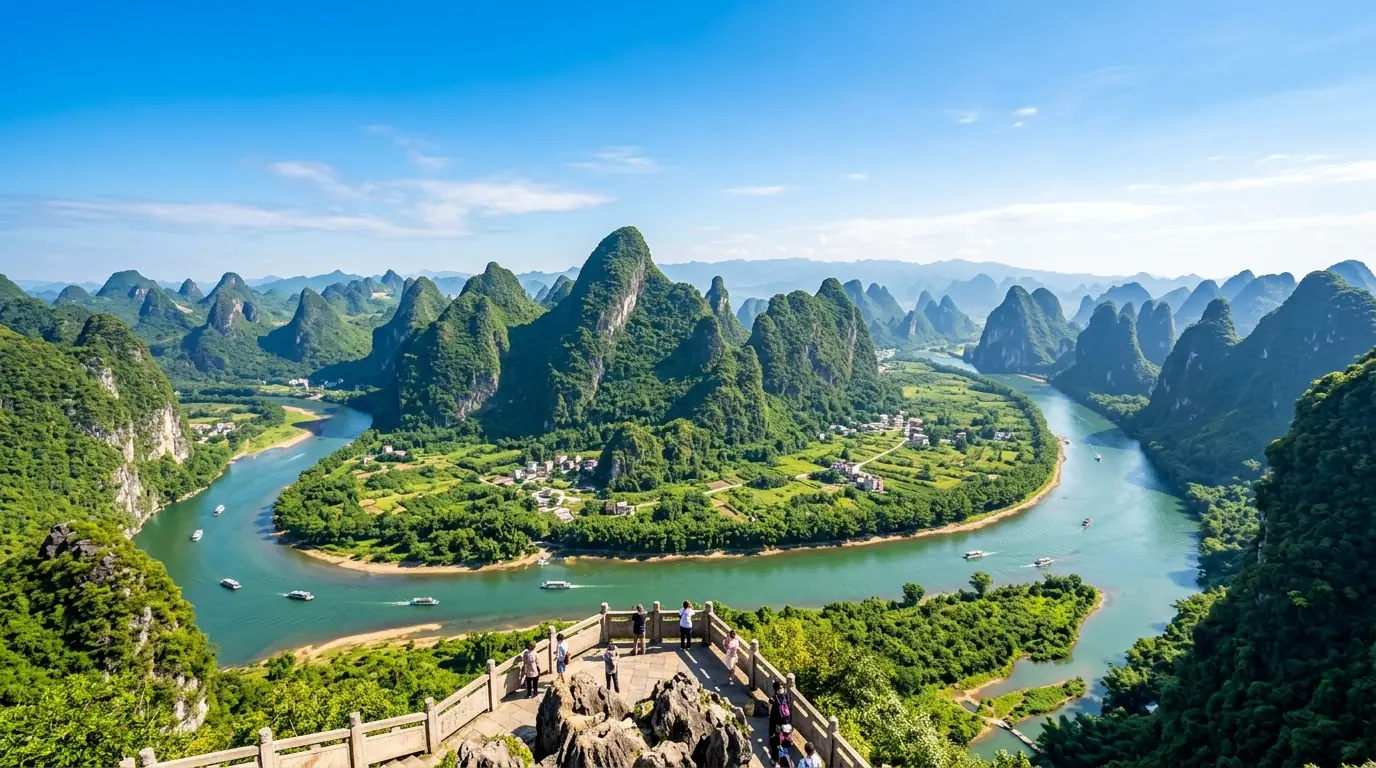
Search for photos of Guilin and Yangshuo online, and you will almost exclusively see emerald summer waters, sun-drenched karst towers, and shimmering green rice paddies under clear blue skies.
Hardly anyone talks about winter (November through February).
Travel agencies often dismiss the colder months as “the off-season,” while glossy lifestyle magazines pretend southern China stays warm all year round. Both narratives are misleading.
The reality? Guilin in winter is a double-edged sword:
- On one hand, it is the most serene and financially rewarding time to visit. Iconic five-star resorts like Banyan Tree Yangshuo and Alila Sugar House slash their rates by 40% to 50%. The infamous 2-hour queues at the Yulong River bamboo raft piers evaporate. The limestone peaks emerge from swirling ribbons of morning fog like a classic Chinese ink-wash scroll.
- On the other hand, if you arrive expecting tropical sunshine or fall for common internet myths about flooded “mirror terraces” in December, you will be unpleasantly surprised.
Here is the unvarnished, field-tested guide to traveling through Guilin, Yangshuo, and the Longji Rice Terraces during late autumn and winter.
1. The Weather Reality: Southern China’s “Damp Chill” (魔法湿冷)
If you look at the raw weather statistics, Guilin winters sound mild:
- November: Highs of 18°C–22°C (64°F–72°F), lows of 11°C–14°C (52°F–57°F). Often the driest and most comfortable month of the year with crisp blue skies.
- December & January: Highs of 10°C–15°C (50°F–59°F), lows of 4°C–8°C (39°F–46°F). Occasional cold snaps can plunge temperatures down to 0°C–2°C (32°F–36°F).
- February: Cool, overcast, and increasingly misty as early spring rains approach.
| Month | Daytime Average | Nighttime Low | Real Feel / Sensation |
|---|---|---|---|
| November | 18°C – 22°C | 11°C – 14°C | Crisp, dry & pleasant |
| December | 11°C – 15°C | 5°C – 9°C | Piercing river drafts |
| January | 8°C – 13°C | 3°C – 7°C | Peak damp chill |
| February | 10°C – 15°C | 6°C – 9°C | Misty, damp & overcast |
The Indoor Heating Shock
There is a crucial geographical fact that catches European and North American travelers off-guard: China’s official central heating line follows the Huai River and Qinling Mountains.
Because Guilin is located in southern China, there is zero public municipal radiator heating.
When it is 6°C (43°F) outside with 85% relative humidity, it is frequently 8°C (46°F) inside unheated restaurants, traditional village guesthouses, and budget hotels. Chinese locals refer to this as Mófǎ Shīlěng (魔法湿冷)—“magic damp cold” that penetrates ordinary cotton jackets and jeans.
When booking boutique hotels or guesthouses in Yangshuo countryside or the Longji Rice Terraces, specifically verify that your room includes underfloor heating (地暖, Dìn-nuǎn) or a heavy-duty inverter AC heat pump. Traditional timber Yao and Zhuang minority stilt houses (Diaojiaolou) have gaps between floorboards and can feel like a refrigerator at night without active floor heating or electric thermal blankets.
2. Does the Li River Dry Up in Winter?
The number one question asked by independent travelers planning a winter trip is: “Can boats still cruise the Li River during the low-water season?”
The short answer is YES—large cruises operate 365 days a year.
Here is the engineering reality behind the dry season (枯水期):
- Ecological Reservoir Regulation: Several massive upstream reservoirs (such as the Qingshitan and Fuzikou dams) maintain scheduled daily water releases. This guarantees a minimum navigable water depth of 1.3 to 1.5 meters along the primary 83-kilometer passenger channel between Guilin (Mopanshan & Zhujiang Piers) and Yangshuo.
- 4-Star Luxury Cruises vs. Open Bamboo Rafts:
- 4-Star Luxury Cruise Boats: Highly recommended in winter. The passenger lounges are fully enclosed, climate-controlled with indoor heating, and feature panoramic double-glazed floor-to-ceiling windows. You stay toasty warm with hot tea while gliding through misty karst valleys.
- Motorized Open Rafts (Yangdi to Xingping): Think twice on freezing, overcast December days. These fiberglass tubes travel at 25 km/h across open water. When icy 5°C river winds funnel through karst gorges for 60 to 90 minutes, unprepared passengers (especially young children and elderly travelers) end up thoroughly chilled. If you take an open raft in winter, wear a heavy windproof parka, woolen beanie, and wind-resistant gloves.
Official Li River 4-Star Luxury Cruise E-Ticket (Guilin to Yangshuo)
From $52 USD · Hot Buffet & Rooftop Deck Access Included
3. Longji Rice Terraces in Winter: Debunking the “Water Mirror” Myth
A rampant piece of AI-generated misinformation circulating on travel forums claims that the Longji Rice Terraces (Dragon’s Backbone) feature “stunning mirrored water reflections in November, December, and January.”
This is factually incorrect.
- The Real Water Mirror Season is APRIL to MAY: Farmers flood the tiered paddies with mountain runoff during the spring plowing season (Chungeng), turning thousands of hectares into glowing silver mirrors before rice shoots are planted.
- What Happens from November to January:
- The golden autumn rice crop is harvested between mid and late October.
- By November, the rice paddies are drained and entered into a fallow resting period (休耕期).
- You will see the raw, sculpted architectural contour lines of 700-year-old black soil ridges against mountain mist. It resembles an immense geological fingerprint carved into the mountainside.
- Between late November and early December, mountain slopes are splashed with autumnal persimmon trees, golden ginkgoes, and rust-red maple foliage.
| Period | Paddy Landscape | Visual Highlights |
|---|---|---|
| Nov – Early Dec | Drained fallow tiers | Bare contour lines, maples & persimmons |
| Late Dec – Jan | Winter fallow / mountain frosts | Ink-wash mist, quiet solitude; rare mountain snow |
| April – May | Flooded paddies | True “Mirror Terraces” plowing season |
| June – August | Vibrant emerald green | Growing rice crops |
| Late Sep – Mid Oct | Radiant golden yellow | Peak harvest season spectacle |
The Winter Snow & Frost Jackpot
While snow is never guaranteed, high-altitude ridges like Jinkeng Dazhai (Golden Buddha Peak / Viewpoint #3, over 1,100 meters elevation) receive 2 to 4 dustings of snow almost every winter between late December and early February.
When an arctic cold front sweeps down from Hunan province, the wooden village roofs and curved agricultural ridges are frosted in white rime and snow, creating one of China’s most breathtaking landscape photography scenes.
When heavy snow or sub-zero freezes hit Longsheng county, the winding mountain access road leading from the ticket gate up to Dazhai and Ping’an can develop black ice. Local traffic police periodically impose temporary vehicle restrictions until roads are salted. If traveling in January, always check current road status with your guesthouse before driving up.
Longji Rice Terraces Scenic Entry & Golden Buddha Peak Cable Car E-Tickets
From $12 USD · Direct QR Admission at Village Gate
4. The Low-Season Financial & Solitude Dividend
Why do experienced travelers intentionally choose November to February? Because the quality-to-price ratio reaches its absolute annual peak.
1. Luxury Resorts at Half Price
During July, August, and national holidays, Yangshuo’s premier design hotels command premium rates and sell out weeks in advance. In December and January, prices plunge:
- Banyan Tree Yangshuo: Private riverside villas drop from ¥3,500+ ($490 USD) to approximately ¥1,700–¥2,000 ($240–$280 USD), often bundled with daily breakfast, afternoon tea, and spa credits.
- Alila Sugar House (阳朔糖舍): The celebrated converted retro-industrial sugar mill offers peaceful courtyards, heated infinity pools, and zero selfie-stick crowds.
- Shangri-La Guilin: Overlooking the tranquil Li River bend in Guilin city, high-floor executive river-view rooms hover around ¥550–¥700 ($78–$98 USD).
Banyan Tree Yangshuo Riverside Luxury Retreat
From $255/night · Private Villas Framed by Karst Peaks
Shangri-La Guilin Riverside Luxury Hotel
From $90/night · Panoramic Li River & Garden Views
2. Zero Queue Rafting on the Yulong River
In peak summer, securing tickets for the popular Shuidi to Gongnong Bridge (水底—工农桥) or Jima (骥马) two-person manual bamboo rafts requires waking up at 7:00 AM to battle scalpers on WeChat mini-programs, followed by 90 minutes standing in line.
In winter, you can often stroll directly up to the ticketing counter, buy your voucher, and float down the jade-green river in near-total tranquility with only the soft lap of the gondolier’s bamboo pole against water.
3. Clear Atmospheric Inversion at Karst Peaks
Summer in northeastern Guangxi brings heavy haze, sudden tropical downpours, and violent thunderstorms.
In late autumn and winter, cooler high-pressure weather creates crisp, stable air. If you hike up Xianggong Mountain (相公山) or Cuiping Wuzhishan (翠屏五指山) for sunrise, you have a significantly higher probability of witnessing dramatic karst cloud-sea inversions (云海): billowing white mist blanketing the valleys while dozens of jagged limestone peaks pierce through like islands in an ocean.
5. Winter Comfort Food: Warming Up from the Inside Out
Cold weather in Guangxi is best countered at the dinner table. Winter brings seasonal regional specialties designed to banish the damp chill:
- Gongcheng Oil Tea (恭城打油茶):
The national intangible cultural heritage of Guangxi’s Yao minority. Fresh tea leaves, crushed old mountain ginger, and garlic cloves are vigorously pounded in an iron mortar, brewed into a peppery, aromatic broth, and poured over crispy puffed rice, fried dough crackers, and roasted peanuts. Two bowls will have you radiating warmth within minutes.
6. Winter Packing Blueprint: The “Three-Layer” Rule
To stay comfortable outdoors without carrying a gigantic suitcase, follow the classic outdoor layering system:
2x Merino wool or thermal Heattech tops & bottoms.
Fleece pullover or lightweight packable down jacket.
Windproof, water-resistant shell jacket (essential for open rafts).
Stainless steel thermos for hot water/tea during mountain day trips.
High-capacity power bank (smartphones drain 40% faster in 5°C damp air).
Broken-in hiking boots with deep rubber tread for wet mountain stone steps.
Final Verdict: Should You Visit in Winter?
- DO COME IF: You appreciate peaceful, crowd-free landscapes; want luxury boutique resorts at bargain rates; love dramatic moody photography at Xianggong Mountain sunrise viewpoint; and don’t mind wearing a fleece jacket and scarf.
- SKIP WINTER IF: You require swimming in warm natural pools, insist on seeing bright golden rice stalks or shimmering water mirrors at Longji, or cannot stand sleeping without central radiator heating.
7. Frequently Asked Questions: Best Time & Winter Logistics
- Is Guilin and Yangshuo worth visiting during December and January?
Yes—December and January offer the lowest hotel prices of the year (40–50% off at Banyan Tree and Alila Sugar House), zero queues on the Yulong River bamboo rafts, and crisp morning cloud-sea inversions. Simply book hotels with underfloor heating (地暖) and pack thermal base layers. - Does it snow in Guilin or Yangshuo in winter?
Snow rarely falls in downtown Guilin or the Yangshuo valley floor (where winter lows stay around 4°C–8°C). However, high-altitude peaks in the Longji Rice Terraces (Jinkeng Dazhai, 1,100m) experience 2 to 4 scenic dustings of snow and rime frost between late December and early February. - What is the best winter itinerary for Guilin and Yangshuo?
Our most popular winter route is the 4-Day Guilin & Yangshuo Classic Itinerary (taking the heated indoor 4-Star Li River Cruise on Day 2) or the 3-Day Yangshuo Countryside Itinerary.